How to Gain Trust and Credibility with Affiliate Product Reviews
Transcendent values like trust and integrity literally translate into revenue, profits and prosperity.
Patricia Aburdene said this, the Author of Megatrends 2010
She wasn’t talking about product reviews. Yet, it’s easy to see how trust and integrity spell the difference between a product review that sucks, and one that’s worth the ‘review’ title.
 2 days ago I spent my Sunday afternoon on a comfy Starbuck’s couch reading Tiffany Dow’s latest e-book ‘Guide to Cashing in on Shiny New Object Syndrome.’
It’s a book about affiliate product reviews, with a twist. This post was meant to be a review for the book, but it turned out to be something very different.
- The basic idea about affiliate product reviews is that you publish a product review on your web site with the goal of making your readers buy the product.
- For every sale you receive a commission.
It’s one of the most common ways to monetize a website.
Writing great reviews, though, can do much more for you than earning a commission. With the right principles in mind, you can use reviews for branding, for positioning, and to build your reputation.
With the right principles in mind, you can build your credibility and become known as a trustworthy person – a person worth doing business with. Business beyond clicking the affiliate link.
Wouldn’t that be great? If –instead of merely hunting for commissions – you could use reviews as pillars for a stellar reputation in your niche market?
But how to do it? The answer lies in the ominous ‘right principles’ mentioned twice above.
Keep reading to discover 4 principles for building credibility, and how to use them in your affiliate product reviews.
The sub title of Tiffany’s new e-book is
“A System that Forces You to Take Action, Gain Trust, and Become an All-Star Info Product Affiliate!”
Like in Aberdeen’s quote, there’s ‘trust’ again.
I’m not a frequent review writer, but a frequent review reader. So, when thinking about writing reviews to earn affiliate commissions, it makes total sense to look at the reader’s point of view first.
After all, the reader of your review is the one to shell out the cash and buy the reviewed product.
Looking at reviews as a reader I have to say, and you’ll very likely agree with me:
The majority of product reviews, especially in the make-money-online industry or internet-marketing industry, is anything but a review.
To me, the gazillions of product reviews on the internet look like this:
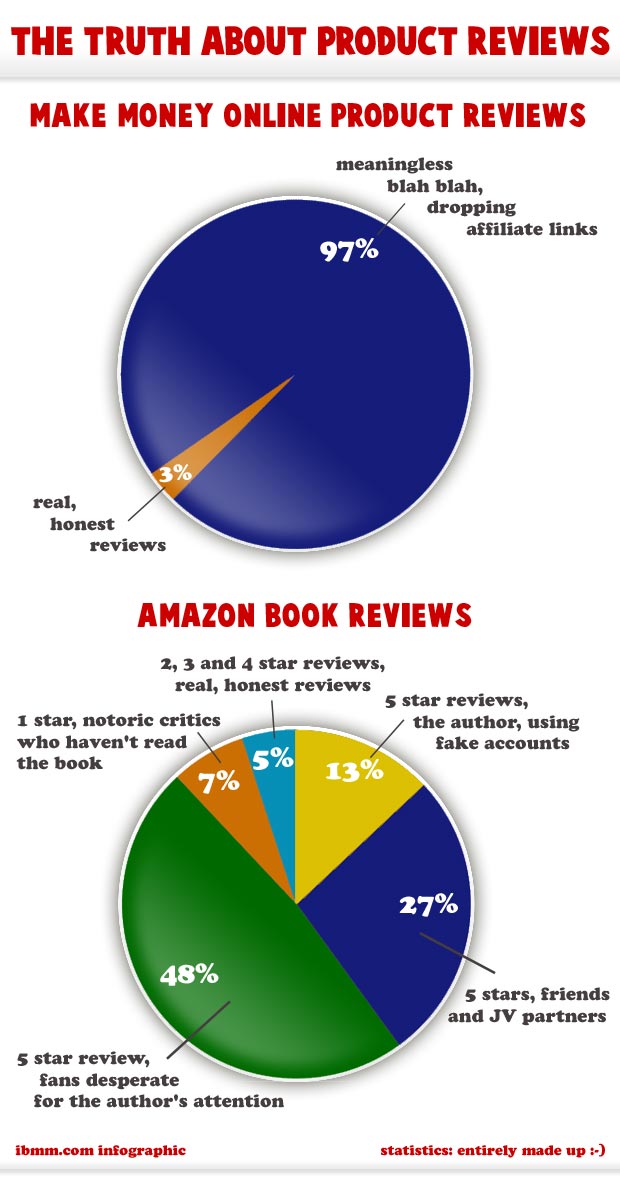
The 5 Types of Reviews You Meet in Hyperspace
1. Most reviews on the web are not affiliate reviews. They are genuine reviews from people who enjoy or feel compelled to voice their enthusiasm, or utter spite, for a product. You’ll find them on personal blogs, in forums, on Amazon.com, Rottentomatoes.com, and many more. These reviews are not written with the intention of making money. Most of all, they aren’t written with search engine optimization in mind.
The reviews, which often pop up in search results, belong to professional review sites. They are product reviews written by people who either earn affiliate commissions, or earn money from advertising on their website. These reviews are search engine optimized; they are the ones that show up when you search for a review for a specific product.
They rarely deserve to be called a review.
2. Lots of review sites are built with automated tools, not giving a review, but merely pulling product names and descriptions from shopping sites with affiliate programs, like ClickBank, Commission Junction, or EBay.
3. Reviews written by humans are often nothing but a shortened, re-worded version of the sales letter. No review at all. Usually, for this type of review, the author hasn’t even seen or used the actual product, ever. These reviews are written by hired freelance writers, who mass produce website content with low quality.
4. Product reviews which deserve the name give you some ‘pros and cons’ of the product, but more often than not they aren’t entirely honest. Instead of being honest, they try to please – not the reader, but the product and the product creator. Tiffany goes into this in more detail in her book.
Professional affiliate reviewers follow pre-determined formulas (review templates) to make you believe you’re reading an honest review. There’s even the advice to ‘add a bit of negativity’ to create the false impression of giving an ‘honest, unbiased’ review. In truth, it’s a disguised product advertisement.
Is all hope lost for humanity?
I think not.
5. There are still a few (one or two, maybe) genuine reviewers who
- Use or read the product/book before reviewing it.
- Care more about giving an honest review to their readers than squeezing the affiliate commission.
And, if you’re an honest reviewer, it doesn’t even have to hurt your commissions.
What if you become known to your readers as a trusted source of honest, useful product reviews?
- Would readership for your reviews increase or decrease?
- Would the likelihood of people acting on your advice (=buying the product) increase or decrease?
Rhetorical questions.
Readers know they are scammed left and right on the internet. Readers crave trustworthy sources of information, trustworthy websites, and trustworthy people.
With sponsored product reviews and glowing endorsements the internet is a low-trust world.
This is where I believe you can set yourself apart. By writing credible, trustworthy reviews you can stand out from the pack and become the go-to resource in your market.
But how is it accomplished? What are the practical elements of an abstract word like ‘credibility’ or ‘trust?’
What are the 4 principles of credibility?
As a professional product reviewer, how do you earn and deserve your reader’s trust?
Stephen M.R. Covey developed a 4-part framework for creating trust.
He’s the son of Dr. Stephen R. Covey (author of the famous book ‘7 Principles of Highly Effective People’). His book The Speed of Trust (Amazon Link) isn’t nearly as well-known as his father’s The 7 Principles of Highly Effective People – but it’s one of my all-time-favorite business books.
It’s a book that can transform how you do business.
Stephen M.R. Covey writes about creating trust:
Contrary to what most people believe, trust is not some elusive quality that you either have or you don’t; rather, trust is a pragmatic, tangible, actionable asset that you can create much faster than you probably think possible.
According to him, trust is gained when 4 components come together. If this is true, then your affiliate product reviews will gain trust and credibility by adding those 4 components.
YOU will gain trust and creditability.
What are those 4 components? And how can you practically use them in your reviews?
Credibility Principle #1: Be a Person of Integrity
Integrity is a buzz word. Glossy biz brochures use it. CEOs use it. Self-help gurus use it. Yet, it’s also one of the most highly valued character traits.
Integrity in life means honesty. Walking your talk. Acting in accordance to your declared values and beliefs. People who speak different than how they act lack integrity, and lack of integrity is one of the most despised, criticized, and mocked character traits in the history of mankind.
Integrity is one of the most important qualities you can develop as a business person; and as a likeable human being too, of course.
How to add integrity to your affiliate product reviews
First of all: be honest. Let your writing match your reality. Say it as it is.
- Review in writing only what you have actually reviewed in real life. Review books only, if you’ve actually read them from start to finish. Review online courses only if you’ve actually taken them. Review nutritional supplements only if you have actually eaten them for a long enough time to be able to make an evaluation.
- Don’t endorse a product only for the purpose of pleasing a guru or JV partner.
- Don’t call mere feature listings a ‘review.’ This doesn’t mean you can’t introduce a product on your site that you haven’t tested. You can, and should. Just make it clear that you haven’t used it.
Credibility Principle #2: Make a Conscious Choice about Your Agenda
When earning commissions, there’s always a conflict of interest. Your reader will worry: Do you have the reader’s best interest in mind, or do you have your commission in mind? As Mahatma Gandhi said:
“The moment there is suspicion about a person’s motives, everything he does becomes tainted.” Mahatma Gandhi
With a product review the conflicting agendas are:
- I want to give the best possible recommendation to my readers.
- I want to earn the biggest possible affiliate commission.
Sometimes it’s easy to get both. The product is great, it’s worth recommending. The commission is great, it’s worth promoting. It’s a win-win situation for a great affiliate review.
Sometimes the best recommendation is NOT for the product with the best commissions. Then you’ll have to choose sides. Will you sell your reader out to get the bigger commission? Will you follow Anakin and join the dark side?
For your goal of building an incredible reputation, the obvious choice is to prioritize your reader higher than maximizing your commission. You may lose a few bucks in the moment, but gain much more in the long run.
Credibility Principle #3: Build Your Qualification
This is a biggie. Are you capable of reviewing the product? Do you have the knowledge and experience to evaluate the product?
- I’ve seen people, who haven’t built a website in their life, promote auto blogging products.
- I’ve seen people, who haven’t earned $100 online, promoting ‘make money online’ products.
- I’ve seen massively overweight, smoking, red nosed people promoting ‘get in shape’ products.
(Side note: Did you ever wonder about those self-help gurus? Why isn’t their advice working in their own life? Why aren’t they demonstrating what they teach?)
The problem is: when you have zero knowledge in a given area, you can hardly give a useful evaluation of the product. You don’t have the competence to evaluate whether the product is accurate and useful.
The only exception to that is a review from a newbie-point-of-view. In that case you explicitly say that you’re a noob and you tell your readers how the product educates and helps you with the topic.
The principle of competence has significant impact for affiliate businesses.
It means to be credible people have to stop ‘niche whoring’ and instead become real experts in one area! Or, stop writing reviews and stop giving incompetent advice!
If you’re articles on ezinearticles.com are across 25 niches, you’re not credible. If you review the latest ‘make money online’ program today and the latest high tech device for brain surgery tomorrow, you’re not credible.
2 strategies for credibility based on competence:
- Stay within your area of expertise.
- Review from newbie-point-of-view.
Credibility Principle #4: Show Your Results
Knowledge is great, but only applied knowledge gives results. Results are the offspring of applied knowledge.
It’s what your readers are after, they’re after the results. They don’t need a nice product review or even a nice product. They need the results from the product.
You will gain a lot of credibility if people see you actually implementing the things you talk about.
- You’re known for your 6 figure subscriber list, and you recommend your favorite list building course to me? Great!
- You’re a super affiliate telling me about how important building a subscriber list is … but when I look at your own site, it doesn’t even have an optin form or a squeeze page? Not so great!
There’s no faster way to credibility and reputation than results.
For affiliate reviews the question is: which products to review in the first place? Don’t make your choice randomly.
Make your reviews about the products you’re actually using to create results in your business and live!
Give examples on what you did, and what results you achieved. Show them links to your sites, pictures of your pounds lost.
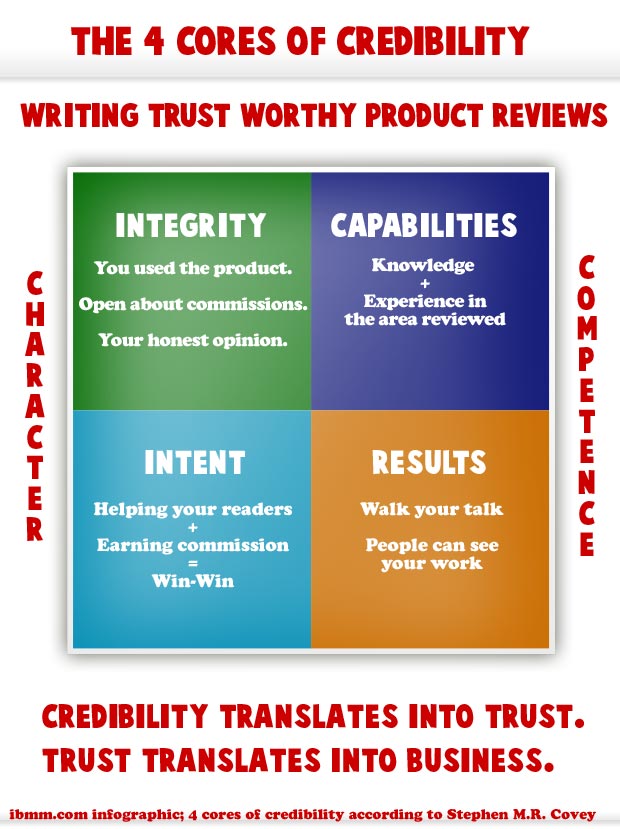
They’re you have it – the 4 principles of credible affiliate reviews!
They’re not a How-to. For a tep-by-step how to write a review check out Tiffany’s Guide to Cashing in on Shiny New Object Syndrome.
The 4 cores are timeless principles of credibility. Keep them in mind, even before you actually start writing your next affiliate review!